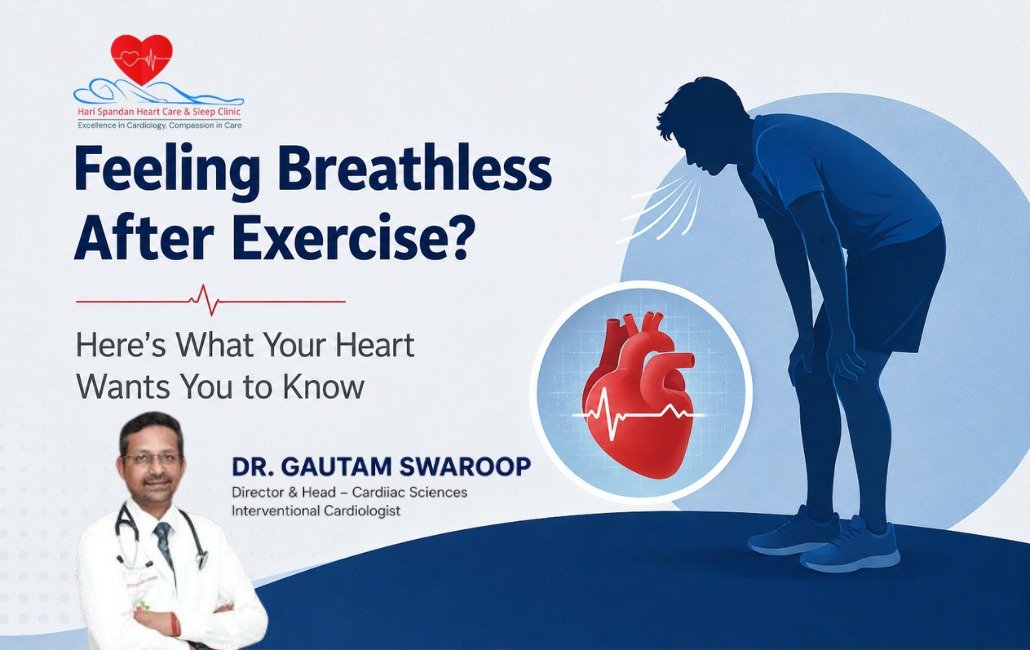
Feeling Breathless After Exercise? Here’s What Your Heart Wants You to Know
Quick Answer: Is it Normal to Be Breathless After Exercise?
It is completely normal to breathe heavily during and immediately after intense physical activity. However, if you feel excessively breathless after mild exertion (like walking up a single flight of stairs), if your breathing takes longer than 10–15 minutes to return to normal, or if the breathlessness is accompanied by chest pain or dizziness, it is a red flag. Your heart may be struggling to pump enough oxygen-rich blood, signaling a potential cardiovascular issue that requires a cardiologist’s evaluation.
Introduction
We all know the feeling of a good, hard workout. Your muscles ache, the sweat is pouring, and your chest is heaving as you catch your breath. That type of breathlessness is a sign that you are pushing your cardiovascular system to become stronger.
But what happens when the breathlessness feels disproportionate to the effort? What if a simple evening walk or climbing a single flight of stairs leaves you gasping for air?
At Harispandan Clinic, our cardiologists frequently hear patients dismiss this symptom by saying, “I guess I’m just getting older,” or “I’m just completely out of shape.” While deconditioning is a real factor, unusual shortness of breath—medically known as dyspnea on exertion—is often your heart’s earliest warning sign that it is under distress.
Welcome to Harispandan Clinic, where our specialists help decode the messages your body is sending you. Here is exactly what your heart wants you to know about feeling breathless after exercise.
Table of Contents
- Normal Panting vs. Abnormal Breathlessness
- What Your Heart is Trying to Tell You (4 Cardiac Causes)
- Red Flag Symptoms You Should Never Ignore
- Is it Your Heart, Your Lungs, or Just Age?
- Next Steps: What to Do If You Are Struggling
- Frequently Asked Questions
- Key Takeaways
- Schedule a Consultation at Harispandan Clinic
Normal Panting vs. Abnormal Breathlessness
Before you panic, it is important to differentiate between an appropriate physiological response and a medical symptom.
| Feature | Normal Exercise Breathlessness | Abnormal Breathlessness (Dyspnea) |
|---|---|---|
| Trigger | Vigorous, high-intensity exercise (e.g., sprinting, heavy lifting). | Mild to moderate activity (e.g., walking, sweeping, dressing). |
| Recovery Time | Breathing returns to normal within 5 to 10 minutes of resting. | Breathing remains labored for 15, 30, or even 60 minutes after stopping. |
| Progression | Remains consistent based on your fitness level. | Gets progressively worse over weeks or months doing the same activity. |
| Ability to Speak | Can usually speak in short sentences. | Unable to speak more than a word or two without gasping. |
What Your Heart is Trying to Tell You (4 Cardiac Causes)
If your breathlessness falls into the “abnormal” category, your heart might be struggling with one of these four underlying issues:
1. The “Plumbing” Problem: Coronary Artery Disease (CAD)
When the arteries that supply blood to your heart muscle become narrowed by cholesterol plaque, your heart doesn’t get enough oxygen. When you sit still, the narrowed artery might supply just enough blood. But when you exercise and your heart rate increases, the demand for oxygen outpaces the supply. Instead of typical chest pain (angina), many people—especially women and diabetics—experience profound shortness of breath as their primary symptom of a blocked artery.
2. The “Pump” Problem: Heart Failure
Heart failure does not mean your heart has stopped; it means your heart is too weak or too stiff to pump blood efficiently. When the left side of your heart cannot pump blood out to the body fast enough, the blood backs up into the blood vessels of your lungs. This fluid buildup in the lungs makes them stiff and heavy, leading to severe breathlessness, especially during physical exertion or when lying flat.
3. The “Electrical” Problem: Arrhythmias
If your heart’s electrical system glitches, your heart may beat too fast, too slow, or erratically (such as in Atrial Fibrillation). When the heart beats erratically during exercise, it loses its coordinated pumping power. Your body suddenly isn’t receiving enough oxygenated blood, causing you to feel instantly winded and fatigued.
4. The “Door” Problem: Heart Valve Disease
Your heart has four valves that keep blood flowing in one direction. If a valve becomes narrowed (stenosis) or leaky (regurgitation), the heart has to work twice as hard to push blood through. During exercise, this mechanical inefficiency quickly leads to a backlog of pressure in the lungs, causing acute shortness of breath.
Red Flag Symptoms You Should Never Ignore
Breathlessness alone warrants a doctor’s visit, but if it occurs alongside any of the following symptoms during or immediately after exercise, you need to seek immediate emergency medical care:
- Chest Discomfort: Pressure, squeezing, tightness, or pain in the center or left side of your chest.
- Radiating Pain: Discomfort that spreads to your neck, jaw, shoulders, or down your left arm.
- Dizziness or Syncope: Feeling extremely lightheaded, as if you are going to pass out, or actually fainting.
- Palpitations: A sudden, racing, fluttering, or pounding sensation in your chest that doesn’t match the level of your workout.
- Cold Sweats: Breaking out in a sudden, clammy sweat accompanied by nausea.
Is it Your Heart, Your Lungs, or Just Age?
It is true that breathlessness can also be caused by lung conditions (like asthma or COPD), anemia, or simply being out of shape (deconditioning).
How do we tell the difference?
If the issue is pure deconditioning, you will gradually improve if you stick to a consistent, safe exercise routine. If the issue is cardiac, trying to “push through it” will not make it better and could actually trigger a severe cardiac event.
The only way to know for sure is through clinical testing. A comprehensive cardiac evaluation—which may include an ECG, a 2D Echocardiogram, and a Treadmill Stress Test—allows our team to see exactly how your heart behaves when it is put under physical demand.
Next Steps: What to Do If You Are Struggling
- Stop and Rest: If you feel abnormally winded, do not try to “power through the burn.” Stop the activity immediately, sit down, and let your heart rate recover.
- Keep a Log: Note down what you were doing when the breathlessness started, how long it took to recover, and if you felt any other symptoms. This history is invaluable to our cardiologists.
- Do Not Self-Diagnose: Avoid attributing severe breathlessness to “just getting old.”
- Schedule a Screening: Book an appointment with our cardiovascular specialists to get a baseline understanding of your heart’s structural and functional health.
Frequently Asked Questions
- 1. I only feel breathless when walking uphill, but walking on a flat surface is fine. Is this a concern?
- Incline walking significantly increases the workload on your heart. While some breathlessness is normal, if walking up a gentle incline leaves you gasping for air when you used to do it easily, it is time for a cardiac check-up.
- 2. Can anxiety mimic exercise-induced breathlessness?
- Yes. Anxiety and panic attacks can cause hyperventilation and a racing heart. However, cardiac causes must always be ruled out first before attributing exercise-induced symptoms to anxiety.
- 3. Should I stop exercising completely until I see a doctor?
- If your breathlessness is accompanied by chest pain, dizziness, or palpitations, yes—stop exercising until you are cleared by a doctor. If it is just mild breathlessness, scale back your intensity to a light, comfortable walk until your appointment.
- 4. What tests will the specialists at Harispandan Clinic perform to find the cause?
- Depending on your symptoms, we typically start with a physical exam and an Electrocardiogram (ECG). We may also perform an Echocardiogram (ultrasound of the heart) or an Exercise Stress Test to monitor your heart exactly when it is working hard.
Key Takeaways
- Heavy breathing during an intense workout is normal; gasping for air after minimal exertion is not.
- Abnormal breathlessness (dyspnea) is often the earliest warning sign of blocked arteries, heart failure, arrhythmias, or valve disease.
- Never ignore breathlessness that is paired with chest pain, dizziness, or a racing heartbeat.
- Do not write off significant changes in your exercise tolerance as simply “getting older” or “being out of shape.”
Schedule a Consultation at Harispandan Clinic
Your heart speaks to you through your physical endurance. If your daily activities or regular workouts are suddenly leaving you breathless and exhausted, it is time to listen to what your heart is saying.
Do not wait for a minor warning sign to become a major medical emergency. Under the expert care of the cardiology team at Harispandan Clinic, you can get to the root cause of your symptoms with advanced, patient-focused diagnostic testing.
Take control of your cardiovascular health so you can get back to living—and exercising—with confidence. Contact our clinic today to schedule your comprehensive heart evaluation.
This article is intended for educational purposes only and should not replace professional medical consultation, diagnosis, or treatment. If you experience severe shortness of breath or chest pain, call emergency services immediately.