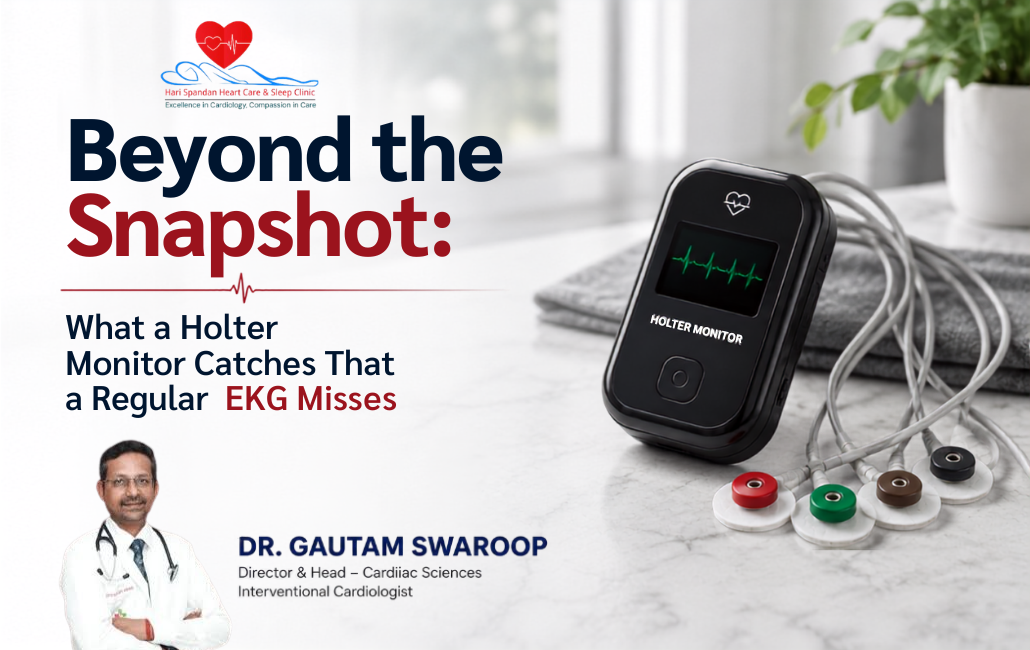
Beyond the Snapshot: What a Holter Monitor Catches That a Regular EKG Misses
Quick Answer: What is the Difference Between an EKG and a Holter Monitor?
An EKG (Electrocardiogram) is a quick, 10-second snapshot of your heart’s electrical activity taken in a clinic. A Holter Monitor is a wearable, continuous ECG device that records your heart’s activity for 24 to 48 hours.
While an EKG detects constant or immediate heart issues, a Holter monitor is essential for catching intermittent problems like sudden palpitations, hidden arrhythmias, or dizzy spells that happen during your normal daily routine.
Introduction
It is a frustratingly common scenario: You are sitting at home or working out when suddenly, your heart starts racing, fluttering, or skipping a beat. You feel dizzy and anxious. But by the time you schedule an appointment and sit in the cardiologist’s office for an Electrocardiogram (EKG), your heart is beating perfectly normally. The test comes back clear, yet you know exactly what you felt.
Are you imagining things? Absolutely not.
At Harispandan Clinic, we frequently see patients who experience this exact frustration. The heart is a dynamic organ, and its electrical system can glitch sporadically. Relying solely on a standard EKG is like looking at a single photograph of a busy intersection and trying to understand the traffic flow for the entire day.
To truly understand what is happening inside your chest, we often need to switch from a “photograph” to a “video camera.” That is exactly where the Holter Monitor comes in.
Table of Contents
- Quick Answer: What is the Difference Between an EKG and a Holter Monitor?
- The Standard EKG: The 10-Second Snapshot
- Enter the Holter Monitor: The Continuous “CCTV”
- What a Holter Monitor Catches That an EKG Misses
- Comparison: EKG vs. Holter Monitor
- Who Needs a Holter Monitor?
- What to Expect at Harispandan Clinic
- Frequently Asked Questions
- Key Takeaways
- Schedule Your Cardiac Assessment
The Standard EKG: The 10-Second Snapshot
An Electrocardiogram (EKG or ECG) is the foundation of cardiac diagnostics. It is painless, non-invasive, and takes only a few minutes. Electrodes are placed on your chest and limbs to record the electrical signals that make your heart beat.
What an EKG does well:
- Detects a heart attack in progress or evidence of a past heart attack.
- Identifies sustained arrhythmias (like atrial fibrillation) that are happening at the exact moment of the test.
- Checks the basic structural electrical pathways of the heart.
The Limitation:
An EKG records roughly 10 to 15 seconds of heartbeats. If your heart happens to be behaving normally during that brief window, the EKG will show a clean bill of health—completely missing the abnormal rhythms that happen while you are sleeping, exercising, or feeling stressed.
Enter the Holter Monitor: The Continuous “CCTV”
A Holter monitor is essentially a portable, miniaturized EKG machine. It consists of a small recording device (roughly the size of a deck of cards) attached to electrodes on your chest. You wear it continuously as you go about your normal life—typically for 24 to 48 hours, though modern variations can be worn for up to two weeks.
Because it records continuously, it captures roughly 100,000 heartbeats in a single day, compared to the mere 10 or 15 beats captured by a standard clinic EKG.
What a Holter Monitor Catches That an EKG Misses
1. Intermittent Arrhythmias
An arrhythmia is an irregular heartbeat. It can beat too fast (tachycardia), too slow (bradycardia), or erratically. Many arrhythmias are paroxysmal, meaning they come and go suddenly. A Holter monitor acts as a 24-hour trap, capturing these fleeting electrical misfires the moment they happen, whether you are at your desk or out for a walk.
2. Symptom-to-Heartbeat Correlation
When you wear a Holter monitor from Harispandan Clinic, we ask you to keep a symptom diary. If you feel a sudden flutter at 2:15 PM, you write it down. Our specialists then cross-reference your diary with the monitor’s data at exactly 2:15 PM. This proves whether your symptoms are actually caused by a cardiac event or if they are related to something else, like anxiety or gastric reflux.
3. Silent Ischemia
Ischemia occurs when the heart muscle does not get enough oxygen-rich blood, often due to blocked arteries. While this usually causes chest pain (angina), it can sometimes happen without any symptoms at all—a condition known as silent ischemia. A standard EKG will miss this unless it happens in the clinic. A Holter monitor can detect the distinct electrical changes that signify blood flow restriction during your daily physical activities.
4. Sleep-Related Cardiac Events
Your heart rate naturally dips while you sleep. However, for some individuals—especially those with obstructive sleep apnea—breathing pauses can trigger dangerous drops in heart rate or sudden, alarming spikes. A standard daytime EKG cannot evaluate your heart’s behavior during the vulnerable hours of sleep.
Comparison: EKG vs. Holter Monitor
| Feature | Standard EKG (ECG) | Holter Monitor |
|---|---|---|
| Duration of Test | 10 to 15 seconds | 24 to 48 hours (sometimes longer) |
| Setting | Doctor’s office or hospital bed | Worn at home, work, and during sleep |
| Best Used For | Immediate emergencies, baseline heart health | Unexplained fainting, intermittent palpitations |
| Patient Activity | Lying perfectly still | Normal daily routine |
| Number of Heartbeats Recorded | ~10 to 15 | ~100,000+ per day |
Who Needs a Holter Monitor?
The specialists at Harispandan Clinic may recommend a Holter monitor if you experience any of the following unexplained symptoms:
- Palpitations: A feeling that your heart is skipping beats, fluttering, or pounding hard.
- Unexplained Syncope: Fainting or sudden bouts of extreme dizziness.
- Shortness of Breath: Especially if it occurs suddenly without physical exertion.
- Post-Treatment Monitoring: To ensure that newly prescribed anti-arrhythmic medications or a recently implanted pacemaker are working correctly.
What to Expect at Harispandan Clinic
If you require a Holter monitor, the process at our clinic is seamless and designed for your comfort.
- Placement: A technician will clean small areas on your chest and attach sticky electrode patches.
- Connection: Wires connect the electrodes to a small recording device, which you can clip to your belt or wear around your neck.
- Your Routine: You will leave the clinic and go about your normal day. You can work, walk, and sleep normally. (Note: Most standard monitors cannot get wet, so you will need to avoid showering or swimming during the 24-hour testing period).
- Logging: You will be given a small diary to log your activities and any symptoms you feel.
- Review: Once you return the device, our cardiologists use advanced software to analyze the massive amount of data, cross-referencing it with your diary to formulate an accurate diagnosis.
Frequently Asked Questions
- Can I use my smartphone or smartwatch instead of a Holter monitor?
While smartwatches with ECG features are fantastic for early detection and have revolutionized personal health tracking, they typically only record a single lead (one electrical view of the heart) and only when you actively trigger them. A Holter monitor records multiple leads continuously, providing the clinical-grade data a cardiologist needs to make a definitive diagnosis. - Does wearing a Holter monitor hurt?
Not at all. The test is entirely non-invasive. You might experience a mild, temporary skin irritation from the adhesive on the electrode patches, but there is no pain or electrical shock involved. - Will the monitor interfere with my daily life?
The devices are small and discreet under clothing. Aside from keeping the device dry and avoiding high-voltage electrical fields (like MRI machines), you are encouraged to stick to your normal routine so the monitor can capture a true reflection of your day.
Key Takeaways
- A standard EKG is excellent for immediate diagnosis but only captures a 10-second snapshot of your heart’s electrical activity.
- A Holter monitor is a 24-to-48-hour continuous recording that acts like a CCTV camera for your heart.
- Holter monitors are crucial for catching intermittent palpitations, fainting spells, and sleep-related cardiac events that an EKG frequently misses.
- Keeping an accurate symptom diary while wearing the monitor is vital for a precise diagnosis.
Schedule Your Cardiac Assessment
Heart symptoms can be anxiety-inducing, especially when initial tests come back normal while the symptoms persist. You know your body best. If you are experiencing unexplained palpitations, dizziness, or chest flutters, do not settle for a mere snapshot.
At Harispandan Clinic, we utilize advanced continuous monitoring technology to uncover the hidden rhythms of your heart. Reach out to our cardiology team today to schedule an evaluation and get the answers—and peace of mind—you deserve.
This article is intended for educational purposes only and should not replace professional medical consultation. If you are experiencing severe chest pain, shortness of breath, or prolonged fainting, seek emergency medical attention immediately.